
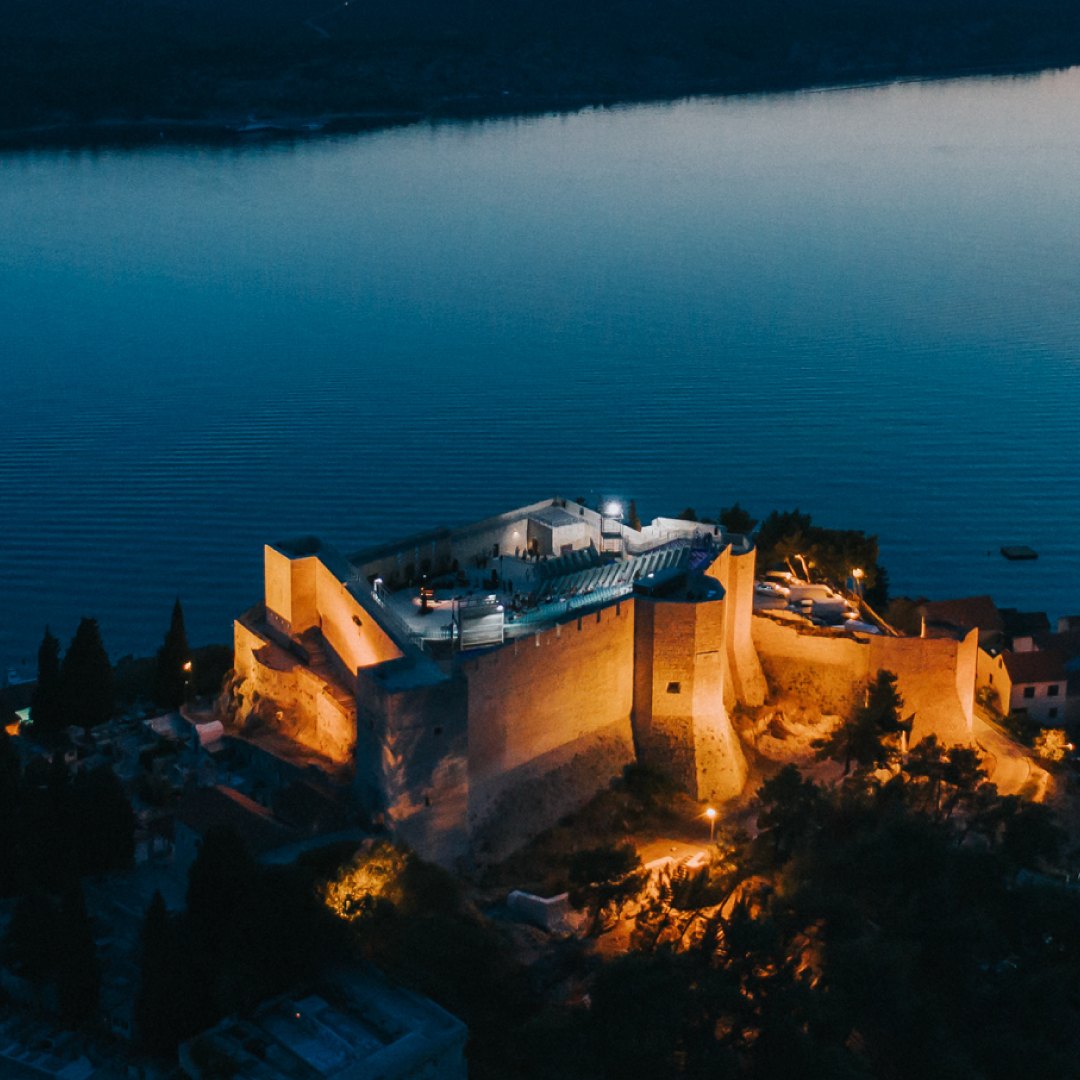
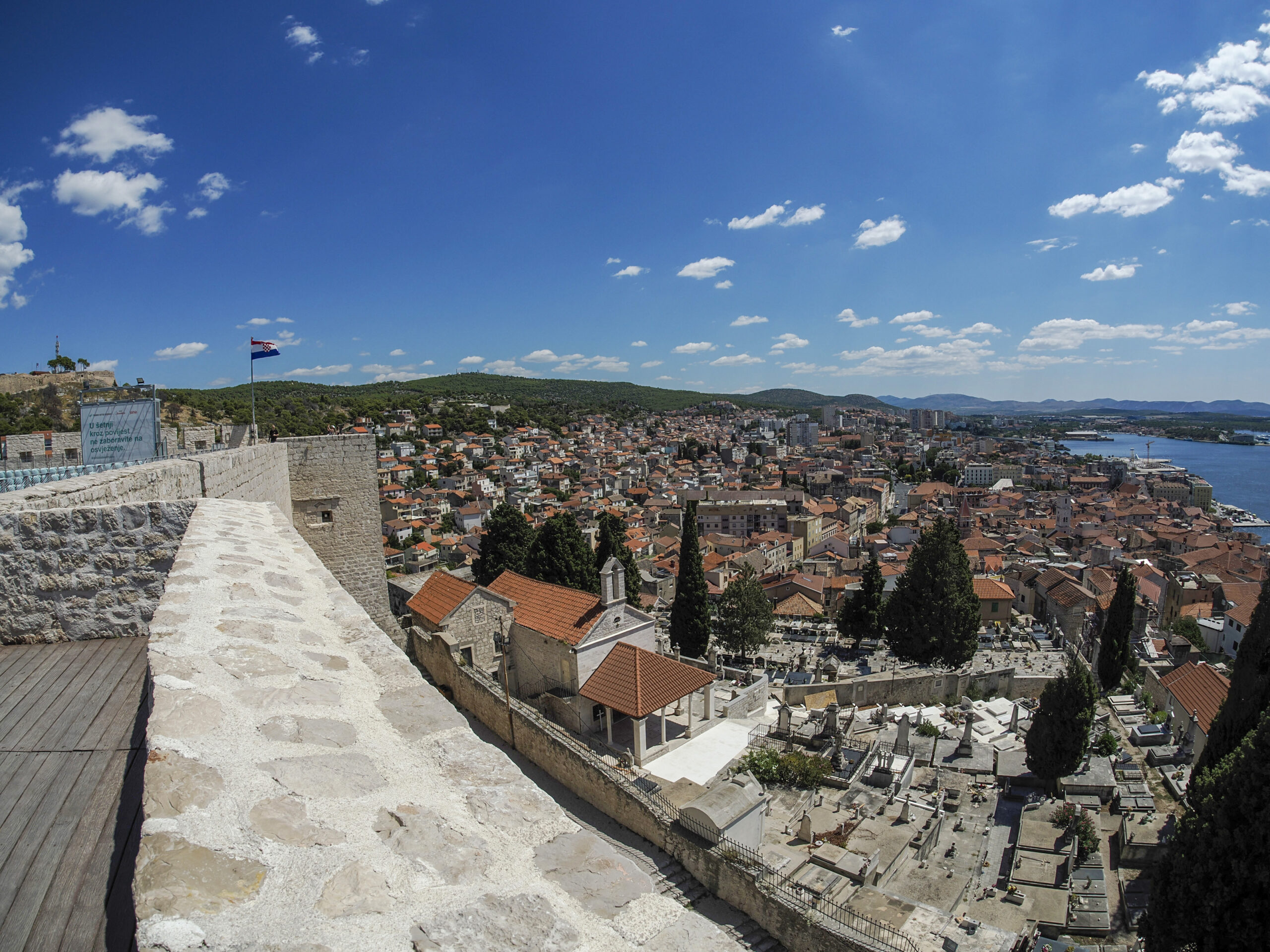
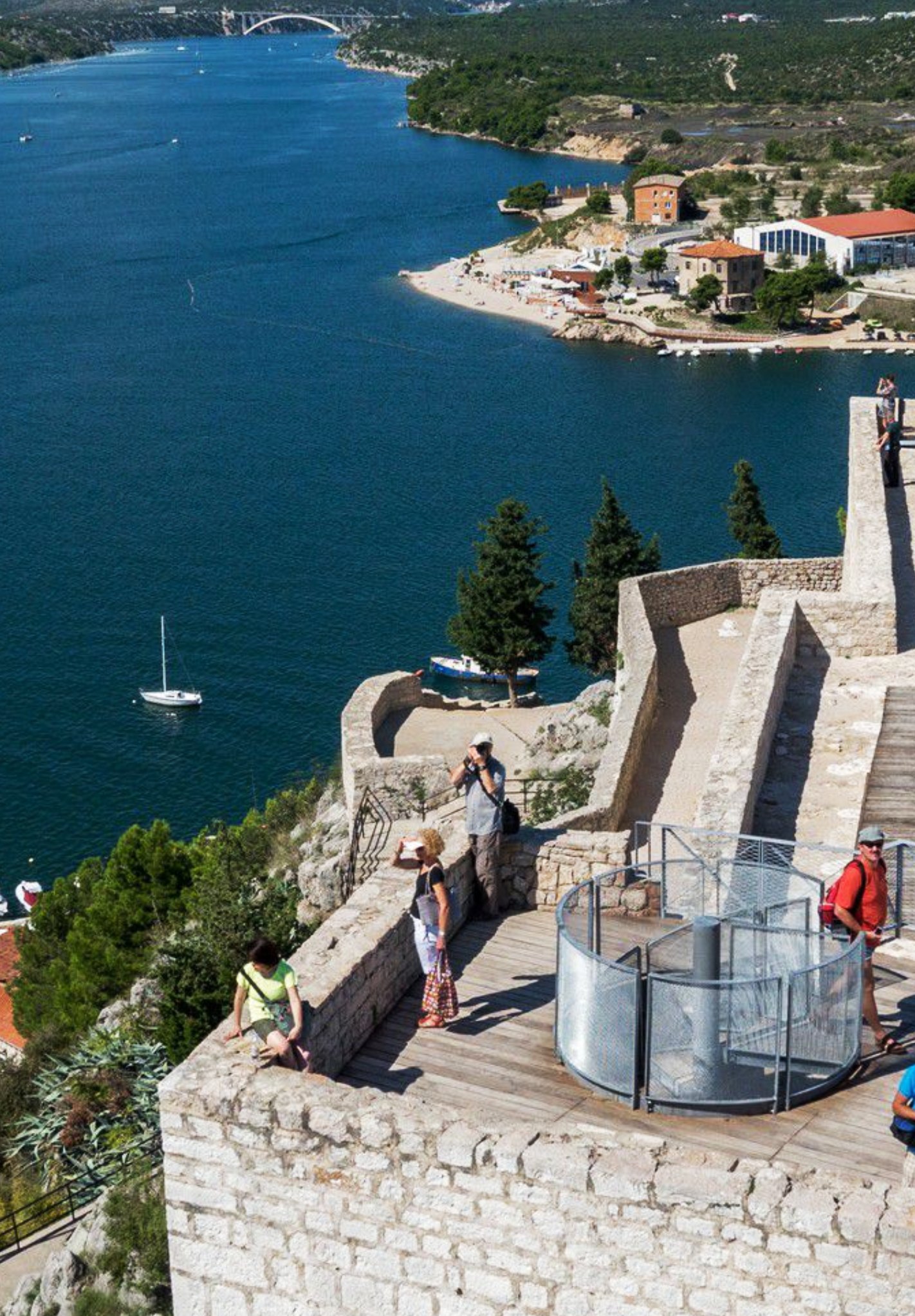

St. Michael’s Fortress, above the Adriatic

The ascent begins in the old town, where narrow streets curve between honey coloured façades, quiet courtyards and steps polished by generations. Laundry moves gently above hidden alleys. A bell sounds somewhere beyond the rooftops. The scent of coffee drifts from a nearby terrace, mingling with warm stone, salt and the faint green perfume of Mediterranean herbs.

This is the pleasure of arriving on foot. The fortress is not simply a monument waiting at the top of a hill. It is the culmination of Šibenik itself. With every turn, the city offers another fragment of its character, intimate, unhurried and deeply connected to the landscape.

St. Michael's Fortress

At the summit, the world opens.

From the fortress walls, Šibenik Bay unfolds below, framed by the channel of St. Anthony and the islands scattered across the horizon. The old town appears almost theatrical from above. Its roofs gather around the Cathedral of St. James, while the sea moves through the scene with a calm, silvery light. Fishing boats trace delicate lines across the water. Ferries and sails pass in the distance. On clear days, the view seems to carry the eye far beyond the city, towards the wider Dalmatian coast.

Yet the beauty of St. Michael’s Fortress is not only in what can be seen from its walls. It lies in the feeling of standing at the place from which Šibenik grew.

The fortress occupies a commanding rocky height above the historic centre, overlooking the bay and the mouth of the Krka River. Its position made it a natural point of defence, but also a place of refuge and authority. The settlement below developed in its shadow, and the story of the fortress became inseparable from the story of the city.

Šibenik was first recorded in 1066, in a charter connected with the Croatian king Petar Krešimir IV. Unlike many towns along the eastern Adriatic that began as Greek or Roman settlements, Šibenik emerged as a Croatian city. That distinction remains a source of local pride, and it gives the fortress a particular significance. This is not merely a structure that protected Šibenik. It is part of the city’s origin story.

Its name comes from St. Michael the Archangel, the historic protector of Šibenik. For centuries, the archangel represented courage, vigilance and divine guardianship, qualities that suited a fortress placed between land, river and sea. A church dedicated to St. Michael once stood within the complex, and although it has not survived, the name remains woven into the identity of the hill.

The walls carry the marks of a long and unsettled history. Rulers changed. Sieges came and passed. The city endured Venetian power, military threats, fires and explosions. In the seventeenth century, a gunpowder explosion damaged much of the fortress. What remains today is therefore not a frozen medieval image, but a layered place shaped by destruction, repair and renewal.

This is the hour when the fortress feels most intimate.

Following its restoration, St. Michael’s Fortress became one of the most distinctive cultural venues on the Croatian coast. Its open air stage now welcomes concerts and performances beneath the summer sky. There is something quietly extraordinary about hearing music in a place once designed for defence. The ramparts no longer separate the city from danger. They frame voices, instruments, applause and the glow of evening.

As sunset approaches, the fortress changes character. The bright geometry of the day softens. The sea turns from blue to pewter, then to rose and gold. Shadows gather among the walls, and the islands become dark silhouettes beyond the channel. Below, Šibenik begins to light its windows.

Visitors linger along the edge of the walls, reluctant to leave. Couples stand in silence. Children peer through openings in the stone. Local residents look across a view they have known all their lives, yet still seem moved by it. The fortress may be one of Šibenik’s great landmarks, but it has never become distant from the life around it. It remains part of the city’s rhythm.

To understand St. Michael’s Fortress, it helps to resist the urge to hurry. Pause in the quieter corners. Notice how the limestone changes colour with the sun. Look down at the maze of streets, then towards the open water. Imagine the generations who watched the same horizon for very different reasons.

Once, the view meant vigilance. Today, it offers wonder.

There is elegance in that transformation. Across Europe, historic fortifications often stand apart from contemporary life, preserved with reverence but little warmth. Here, the past has been treated differently. It has been respected, restored and invited back into the present. The result is a place that feels culturally significant without becoming solemn, and sophisticated without losing its humanity.

A visit also reveals something essential about Šibenik. This is a city that rewards attention. It does not announce itself with the grandeur of larger Adriatic destinations. Its beauty is more textured and personal. It is found in carved stone, steep stairways, shaded squares, the voices of neighbours and the sudden appearance of the sea at the end of a lane.

Share
Pin
Tweet
Related
Comments

What do you think?

3 Comments:
August 22, 2021

I love reading your blogs and watching your video. I am really impressed by the way you are doing business and I am just inspired by it!

August 22, 2021

As a new Interior Design student, I find your tips to be incredibly helpful, interesting, and inspirational. Keep up the great work! Thanks so much for your work both in the blog and on your YouTube channel.

August 22, 2021

I’ve just discovered your Youtube channel, and I love it! Thanks for sharing your content and the day and life of a designer! Great tips!

Leave a Reply

Your email address will not be published. Required fields are marked *

instagram:

This error message is only visible to WordPress admins

Error: No feed with the ID 8 found.

Please go to the Instagram Feed settings page to create a feed.